What land clearing actually involves
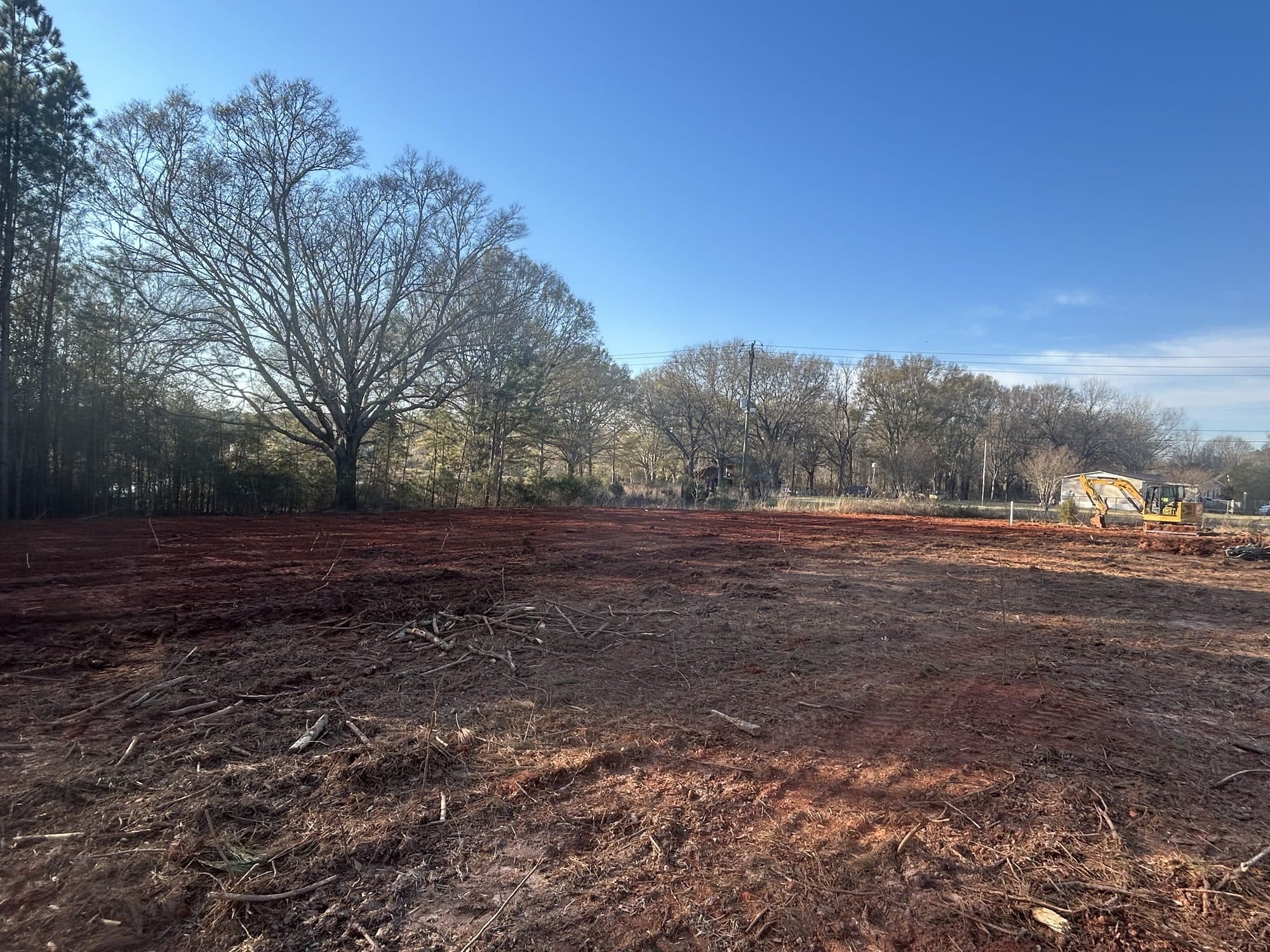
Clearing is more than cutting trees down. A lot that looks empty can still be full of root balls, buried stumps, brush piles and soft ground that will not carry a foundation or a drive. The work usually runs in the same order: mark what stays, cut and remove what goes, deal with the stumps, then rake and clean the surface so what is left is soil rather than a mat of roots and splinters.
What stays matters as much as what goes. Property corners, septic areas, the specimen oak the owner wants kept, the drip line of trees along a boundary, overhead lines and buried utilities all get identified before anything is cut. Getting this wrong is expensive and occasionally dangerous, which is why we walk the site with you first rather than quoting from a satellite photo.
Three ways to handle the debris
Every clearing job produces a large volume of material, and how it leaves the site is usually the biggest single factor in the price.
Haul-off means the material is loaded and trucked away. It leaves the cleanest site and it is the most predictable, but you are paying for trucking and for disposal, so haul distance matters.
Burning is the cheapest route when it is allowed. Rules vary by county and by season, and open burning needs a permit and safe conditions on the day. It can only be part of the plan where the county permits it.
Forestry mulching grinds standing growth into mulch and leaves it on the ground. Nothing is hauled and nothing is burned, so it is often the least expensive option, and the mulch layer holds soil in place and suppresses regrowth for a while. The trade-off is that the material stays on your lot, so mulching suits recovering overgrown land, trails and fence lines better than a site that needs to be stripped clean for construction.
Erosion control and land-disturbance permits
Clearing counts as land disturbance, and past about an acre both states want paperwork before the first tree comes down.
In North Carolina, a land-disturbing activity that disturbs more than one acre needs an approved erosion and sedimentation control plan, submitted at least 30 days before work starts. It goes to the NC Department of Environmental Quality, or to the local program in counties and cities that run their own, and those local programs can be stricter than the state.
In South Carolina, disturbing more than one acre requires coverage under the state Construction General Permit from the SC Department of Environmental Services before land disturbance begins. Under an acre in a non-coastal county, a notification form goes to SCDES and they issue a letter confirming no further coverage is needed.
Silt fence, checked entrances and stabilized soil are not box-ticking. Bare ground moves in the first heavy rain, and sediment that reaches a ditch or a creek becomes someone's violation. Tell us the acreage when we come out and we will tell you which of these rules your job falls under before anything starts.
Clearing before septic, driveways and building pads
On most of our jobs, clearing is step one of a larger scope. A new home on a wooded lot needs the building envelope and the driveway cleared, the pad cut and compacted, a septic system sized to the bedroom count and utility runs trenched to the house. Doing that with one crew means the clearing is done with the later stages in mind: the drain field area is not compacted by heavy traffic, the driveway route is cleared to the width the trucks will actually need, and spoil from the pad has somewhere to go.
It also means one schedule and one point of contact. If clearing exposes rock, a wet-weather spring or a soil problem, the people who will do the grading and the septic are already standing there.